
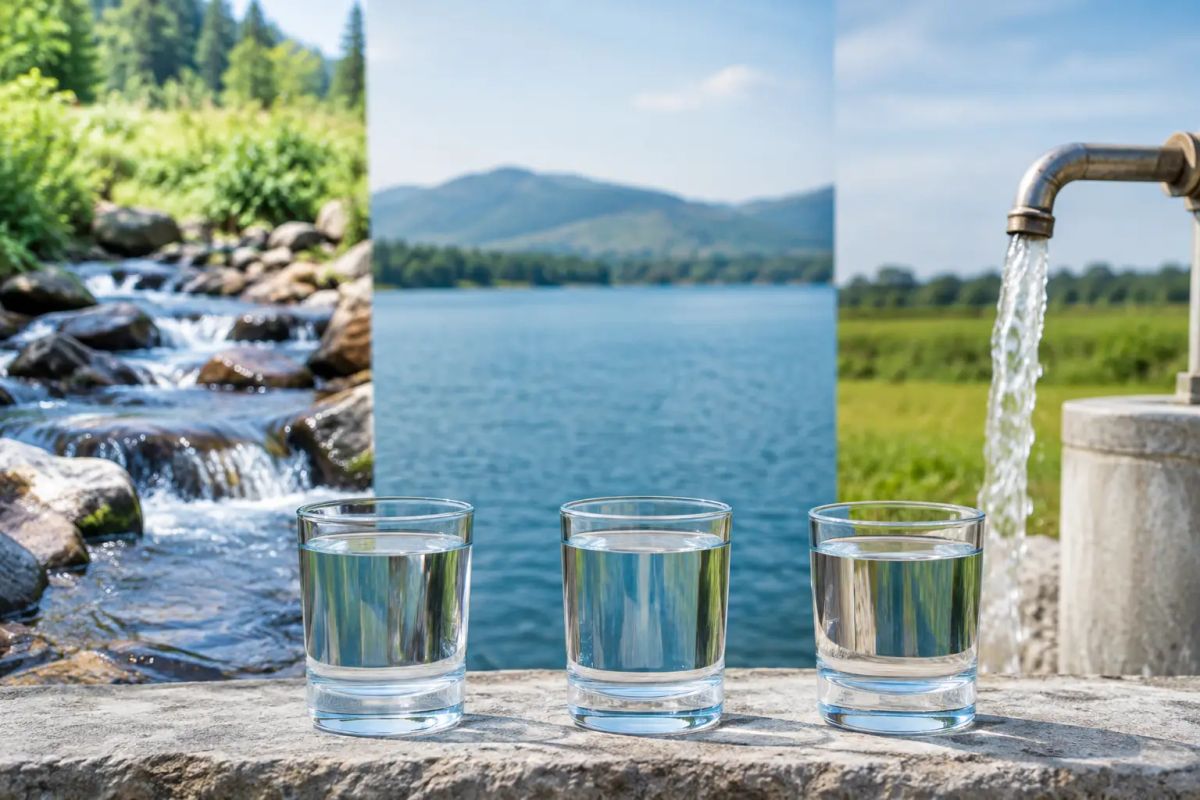
A bottle’s source statement can tell a more compelling story than its front label ever could. To compare water source origins well is to look beyond a mountain silhouette or a pristine-sounding name and ask a better question: where did this water begin its journey, and what did it encounter along the way?
There is a world inside every bottle. Rainfall, rock strata, underground residence time, and the way a producer captures water all leave their mark. Origin does not declare a water objectively “better.” It gives you context for its mineral profile, texture, and sensory character - the same way place helps explain a wine, coffee, or olive oil.
Why Water Source Origin Changes the Experience
Water begins as part of the natural water cycle, but its path can be remarkably different from one bottle to the next. Some water rises naturally at a spring after moving through underground formations. Some is drawn from a deep aquifer. Some originates from glaciers or protected surface waters. Each route creates a distinct starting point for understanding what is in the glass.
As water moves through rock and soil, it may dissolve trace amounts of minerals. Calcium, magnesium, sodium, bicarbonate, sulfate, and silica can contribute to a water’s measured composition. Those figures do not translate into taste by themselves, but together they offer useful clues. A water higher in bicarbonate may feel structured and quietly alkaline in character. A low-mineral water may seem light, clean, and fleeting. Mineral balance, rather than any single number, shapes the impression.
The key distinction is this: origin describes the water’s provenance. Mineral analysis describes the composition associated with that provenance. One is the story of place; the other is evidence you can read.
How to Compare Water Source Origins
Begin with the exact source language on the bottle. “Spring water,” “artesian water,” “mineral water,” and “glacial water” are not interchangeable descriptions, even when the branding makes them feel similar. The most useful labels name a spring, aquifer, region, or protected watershed rather than relying solely on broad imagery.
Then compare origin alongside mineral data. If two waters both come from springs, they can still taste entirely different because their underground journeys are different. One may pass through limestone-rich formations, while another travels through volcanic rock or granite. The source category is a useful first chapter, not the entire book.
Finally, account for bottling practices. A source can be natural and still be presented in different ways, including still or sparkling formats. Carbonation can significantly change aroma, texture, and how minerals register on the palate. When comparing bottles, make sure you are comparing like with like.
Spring Water: Defined by Emergence
Spring water comes from an underground formation and flows naturally to the surface, or is collected from the formation through a borehole. Its appeal is immediate: water that has completed an underground passage and emerges at a named point of origin.
But “spring” is not a flavor profile. A soft spring water may have very low total dissolved solids, or TDS, and a delicate finish. Another spring water may carry more calcium and bicarbonate, producing greater weight and a longer, chalkier impression. The name of the spring and the published mineral analysis matter more than the category alone.
For a table setting, spring waters are often versatile. Their character can range from nearly neutral to notably mineral, so the right choice depends on the meal and the effect you want from the water.
Artesian Water: Shaped Under Pressure
Artesian water is drawn from a confined aquifer, where water is held between less permeable layers of rock or sediment and naturally under pressure. The term speaks to geology and extraction conditions, not automatically to a particular mineral level or taste.
Because aquifers can be deep and protected by geological layers, artesian water often carries a strong sense of place and time. Yet depth alone is not a shortcut to quality or intensity. Some artesian waters are restrained and silk-like; others are broad, mineral-forward, and saline in character. Read the numbers before making assumptions.
When tasting, notice the mid-palate. Does the water feel rounded, creamy, crisp, or firm? That texture can be more revealing than a dramatic source claim.
Mineral Water: Composition Is Central
Natural mineral water is usually discussed through its stable mineral composition and source-specific identity. On a label, it may offer one of the clearest opportunities to connect geology with flavor. Calcium can lend a stony or structured sensation; magnesium may add a subtle bitter edge; bicarbonate can create lift and breadth; sodium can suggest softness or a faint savory note.
TDS is especially useful here, though it should not be treated as a scorecard. It measures the combined amount of dissolved material in water. A lower TDS water is often lighter in character, while a higher TDS water may be more assertive. Neither is inherently superior. A delicate raw bar may call for restraint; a rich cheese course can stand up to more mineral presence.
Glacial and Surface Origins: Read Beyond the Romance
Glacial language is evocative, and it can point to a cold-climate or mountain-fed origin. Still, it is worth looking for precision. Is the water sourced from glacial melt, a spring in a glacial landscape, or a watershed fed by snow and ice? Those are different stories.
Surface-origin waters, including those associated with lakes or protected watersheds, may have a different mineral character from water that has spent long periods traveling through deep rock layers. Often, though not always, they can present with a lighter dissolved-mineral profile. The producer’s source details and analytical information remain the best guide.
Build a Better Comparison Than “Pure” Versus “Mineral”
“Pure” is a powerful marketing word, but it is not a complete tasting note. A better comparison considers four connected details: the named origin, the geological route, the mineral analysis, and the final sensory impression.
Start by lining up two or three bottles and recording source type, named location, TDS, and the minerals listed in meaningful amounts. Then taste them at a similar temperature in clear glasses. Take a small sip and pay attention to the opening, texture across the tongue, and finish. Does the water disappear quickly? Does it feel plush? Is there a dry, mineral persistence after the sip?
Avoid trying to force every sensation into a single ingredient. A water’s character is the cumulative effect of dissolved minerals, carbonation if present, temperature, and your own palate. Numbers orient the tasting. They do not replace it.
A Useful Way to Read the Label
Look first for the source name and source location. Specificity is valuable because it makes the origin more intelligible. Next, find the mineral panel or water-quality analysis, paying particular attention to calcium, magnesium, sodium, bicarbonate, and TDS when available. pH can also provide context, but it should be read as one measurement, not a verdict on taste or quality.
If the label offers limited detail, use the bottle as an invitation to stay curious rather than a reason to guess. Water Sommelier can help identify a bottle with your phone camera and present available source-origin, mineral, pH, and TDS information in one clear view. Point. Shoot. Know.
Match Origin to the Moment
A water’s origin becomes most interesting when it is part of a choice. For a quiet afternoon, you may prefer a low-mineral water with a clean, almost weightless profile. For dinner, a more structured, mineral-rich water can hold its place beside food without feeling like an afterthought. Sparkling water adds another variable: bubbles amplify texture and can make mineral notes feel more vivid.
This is not about finding one correct bottle. It is about building vocabulary for preference. A deep aquifer may intrigue you for its geological story; a bright spring water may win you over at first sip. The most memorable water is often the one whose origin, composition, and occasion feel beautifully aligned.
Next time you choose a bottle, pause at the source line. It is not fine print. It is the first sentence of the water’s story - and a more interesting place to begin tasting.
Scan any bottle. Discover its minerals, origin, and character. Get the Water Sommelier app.