
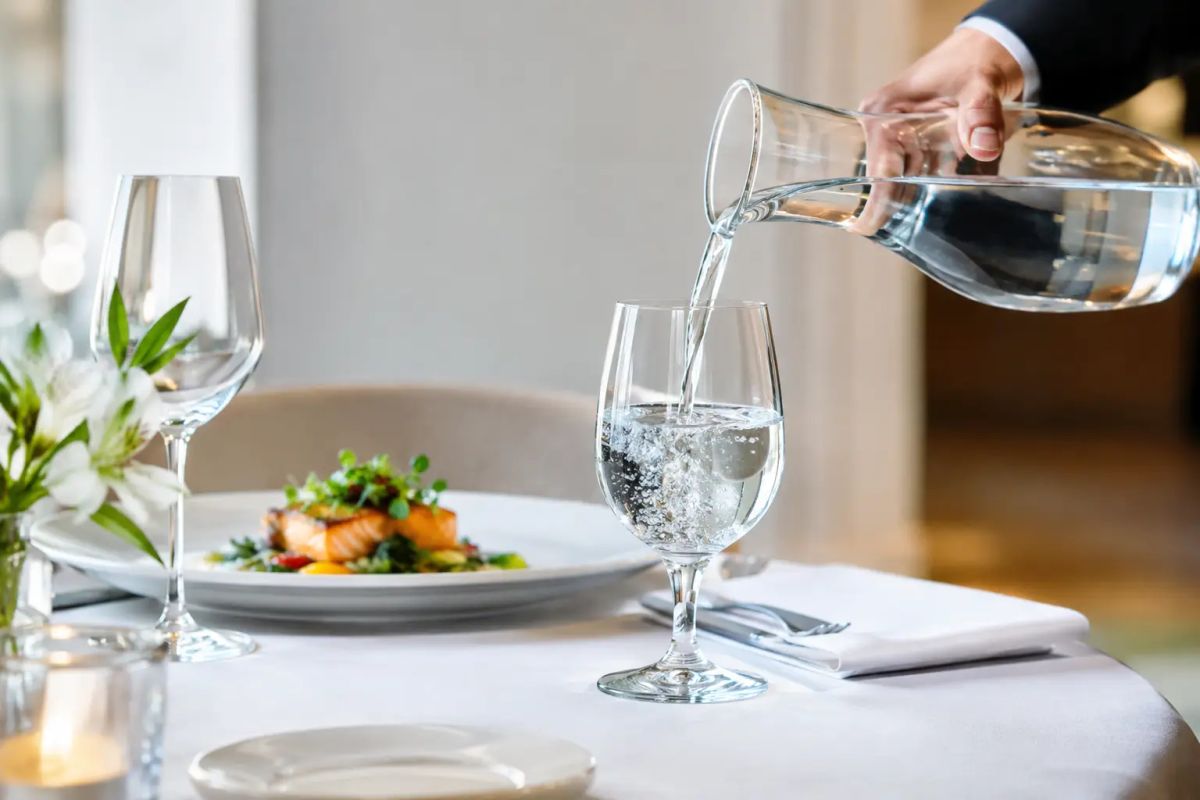
The water glass arrives before the first course, polished to a clear gleam and placed just above the knife. It may seem like the least consequential detail at the table. Yet fine dining water etiquette is one of the quietest signals of ease: knowing when to let service lead, how to hold the glass, and how to appreciate what has been poured without turning a meal into a performance.
Water belongs to the rhythm of a fine meal. It refreshes the palate between bites, carries a source story, and, in the right setting, can be selected with as much thought as bread, wine, or tea. The goal is not to demonstrate expertise. It is to be present, gracious, and curious.
Fine Dining Water Etiquette Begins With the Glass
In a formal place setting, the water glass is typically positioned above the dinner knife. If several stemmed glasses are present, water is generally the larger glass nearest the center or just above the knife, while wine glasses sit to its right. There is no need to memorize every variation. Let the table setting and the server’s pour orient you.
Pick up the glass by its lower bowl or stem, depending on its design. A light, natural grip is all that is required. Avoid wrapping a hand around the upper bowl for long periods, particularly with chilled water, as fingerprints and warmth can distract from the experience. With a tumbler, hold it around the lower half.
Sip rather than gulp. This is less about rigid formality than pace. A small sip between courses or after a flavorful bite lets water do what it does best at the table: create a clean pause. Set the glass down gently in its original area instead of moving it across the table or placing it near your plate.
If you are wearing lipstick or using a napkin, a quick, discreet blot before drinking keeps the rim neat. These small gestures are not rules designed to make dining tense. They preserve the visual calm that excellent service works hard to create.
Still or Sparkling: How to Answer Gracefully
“Still or sparkling?” is often the first question a server asks. A direct answer is ideal: “Still, please,” “Sparkling for the table,” or “Could we have one of each?” There is no need to explain your choice.
Still water tends to disappear into the background, which can be precisely right for delicate dishes, nuanced wine pairings, or a meal where you want the food to lead. Sparkling water brings lift, texture, and a more pronounced visual presence. Its bubbles can feel especially fitting alongside rich or fried dishes, though a highly carbonated water may compete with very subtle flavors. Preference matters more than convention.
For a group, ordering a bottle to share is common. If guests have different preferences, it is perfectly acceptable to request both still and sparkling. At a business dinner or when you are hosting, ask the table once, then make a clear choice. Repeatedly polling everyone over water can interrupt the opening rhythm of the meal.
A server may present a bottled water label before opening it. This is a courteous confirmation, especially if the restaurant offers a curated selection. A brief acknowledgment is enough. You do not need to inspect the bottle as you would a wine label unless you genuinely want to know more.
Let Service Set the Pace
In traditional fine dining, a server may pour water for you throughout the meal. When that happens, leave the glass where it is and allow the server to handle it. Reaching across, lifting the glass mid-pour, or topping it off yourself can make a polished interaction suddenly awkward.
If the bottle is left on the table, use it thoughtfully. Offer it to others before serving yourself, especially when you are closest to it. Pour slowly, stopping well before the rim. A glass filled about two-thirds full is comfortable to hold and leaves room for movement. With sparkling water, pour even more gently to manage the foam.
Do not feel obligated to finish every pour. Fine service often includes frequent refills, and water is served in modest amounts for a reason. A glass that remains partly full is not a judgment on the restaurant or the selection. It simply means you are drinking at your own pace.
If you would prefer no more water, a polite “I’m all set, thank you” is entirely sufficient. Turning a glass upside down or covering it with a napkin is generally unnecessary and can appear theatrical. Clear words are more elegant.
When the Water Is Poured as a Pairing
Some restaurants present water as part of the tasting experience, with selections chosen for mineral character, texture, or carbonation. Listen to the introduction. The most useful response may be a simple question: “What made this a good match for the course?”
This invites a meaningful conversation without demanding a lecture. A knowledgeable server might mention a soft texture, a crisp mineral finish, or a source with naturally occurring calcium, magnesium, sodium, and bicarbonate. Those details can shape how water feels on the palate, much as roast level shapes coffee or grape variety shapes wine.
Taste it before and alongside the dish. Notice whether it feels light, rounded, saline, creamy, sharp, or effervescent. These words are not reserved for professionals. They are practical ways to describe a sensory experience that is already happening in your glass.
How to Taste Water Without Making It a Ceremony
A fine restaurant is not a silent laboratory. If you are curious about a bottled water, taste with attention but keep the ritual relaxed. Look at the water first only if presentation makes that worthwhile. Clarity is expected; the more interesting clues are usually aroma, texture, and finish.
Take a small sip and let it move across your palate. Is the impression clean and brisk, or rounded and weighty? Does it finish quickly, or leave a faint mineral note? With sparkling water, consider the size and persistence of the bubbles. Fine bubbles can feel delicate; more forceful carbonation may feel lively and assertive.
Then return to the food. The point of pairing is contrast or harmony, not a verdict. A mineral-forward water may stand up well to a savory dish. A low-key still water may give an intricate course more space. But there are no universal pairings, because recipes, sauces, temperature, and personal perception all matter.
If the bottle interests you, read its label after the meal or when the table is settled. Source origin, mineral composition, pH, and total dissolved solids offer useful context, but they are not a scorecard. Data explains part of the experience. Taste completes it.
Water Sommelier can help turn that curiosity into a clearer understanding. Point your phone camera at a bottle to identify it and view educational information about its origin, mineral composition, pH, and TDS. The best time to use it is not necessarily while a server is speaking or guests are waiting. A quiet moment between courses, or after dinner, keeps curiosity considerate.
The Social Etiquette Matters Most
Fine dining is shared space. The most polished water etiquette is not about identifying the rarest source or using specialized vocabulary. It is about reading the room.
If someone asks about the water, share what you notice in plain language. “This one feels more mineral-driven,” or “I like how fine the bubbles are” opens the door without taking over the table. If no one asks, there is no need to narrate every sip. Enthusiasm is inviting when it leaves space for others.
Avoid criticizing a guest’s choice of still, sparkling, bottled, or house water. Water preference is personal, and the table is not the place for correction. Likewise, if a bottle is presented with ceremonial attention, receive it with interest but without pressure to perform appreciation. A sincere “Thank you” is always appropriate.
When hosting, keep an eye on the practical details. Make sure guests have access to their preferred water, ask for a refill when the table needs one, and do not let an empty bottle become a distraction. These are modest acts of hospitality, but they change the comfort of a meal.
A thoughtfully poured glass does not need a grand speech. Notice its source, its texture, its role beside the plate. Then take a sip, return to the conversation, and let the meal continue with its natural grace.
Scan any bottle. Discover its minerals, origin, and character. Get the Water Sommelier app.